


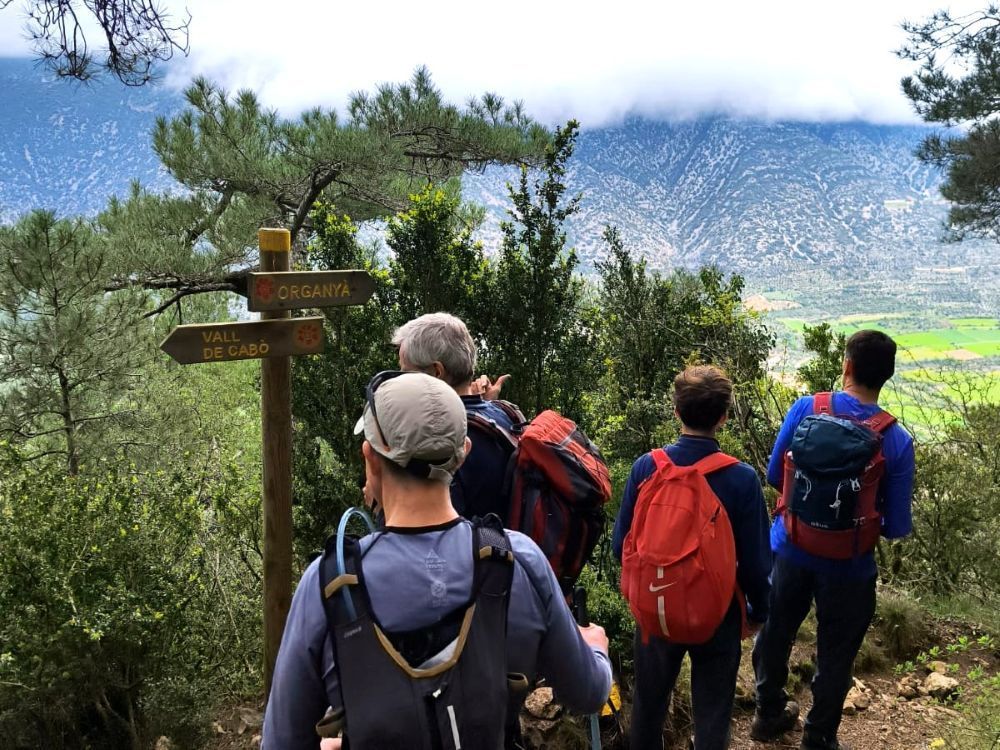
Descending from the Santa Fe chapel towards the Vall de Cabó i Organyà
On Saturday, April 26, we met at the public parking lot of Coll de Nargó to take a circular route following part of the third and fourth stages of the Way of Saint Josemaría, along with other itineraries around Coll de Nargó and Organyà. A good combination to relive this historical journey and enjoy a natural and cultural environment of interest.
The threats of bad weather and rain caused several participants interested in the walk to pull back at the last moment. Finally, John Tangen, a Swede, his wife Catherine Tangen Ramos, from the Philippines, Jordi Pérez and Josep Maria Torné with a nephew of his, joined the walk.

At the start of the Walk
The walk began with overcast skies and a chance of rain, but with spirits high, knowing that it would not be a hot day. The first section, from Coll de Nargó to the Pallerols to Andorra Trail, next to the Sallent River, allowed us to discover valleys and hills that we had not seen much before. Following the blue and yellow markings of the St. Josemaría road, we soon arrived at the hermitage of Sant Jaume, and shortly afterwards we began the climb to the Barraca de Coma la Vall, where we took the opportunity to pray a rosary and join the funeral of the Holy Father Francis, which was taking place at that time.
We arrived at Can Fenollet after noon. There, in front of what had been the sheep pen where the group of fugitives had been hidden, we remembered the good welcome they received from this family, who gave them plenty of food to regain their strength and continue their journey towards Andorra. Rosa herself, the mistress of the house, daughter of Eugeni Coll, who at the age of 13 obtained food for the refugees who stopped at Can Fenollet without raising suspicions, told us details of the passage of Saint Josemaría. We did not leave without taking some souvenir photos with her first.
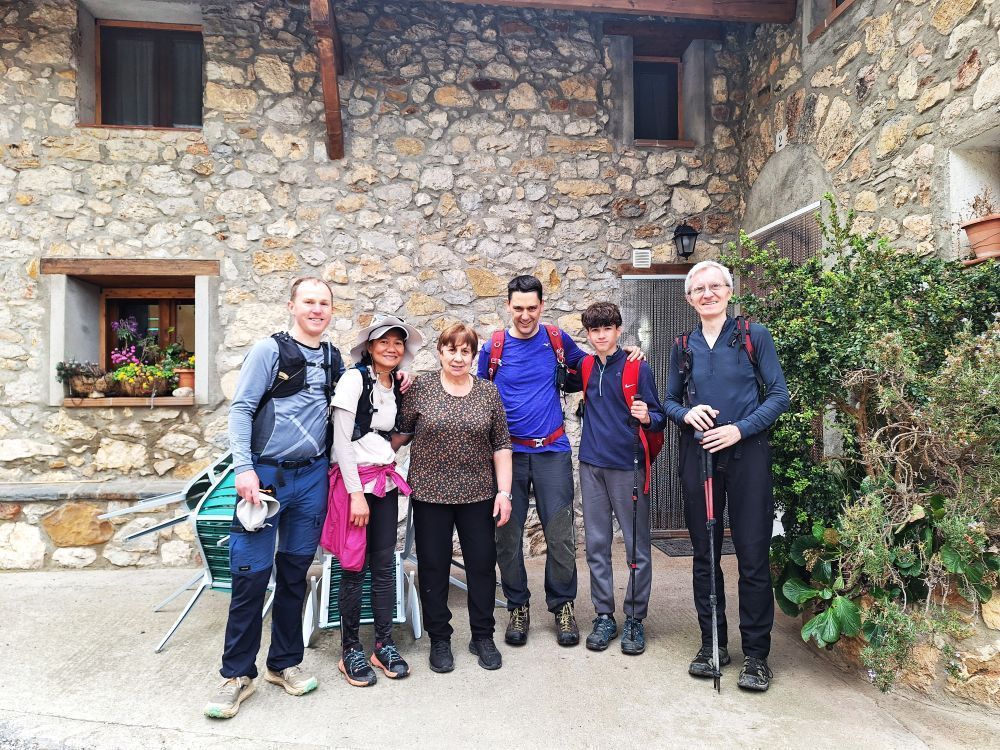
At Fenollet’s house, with Rosa
Then the hard climb to Santa Fe began, with good views of the valleys. We were surprised when crossing one of the ravines on the way to find a strong waterfall, the result of the recent rains of these days.
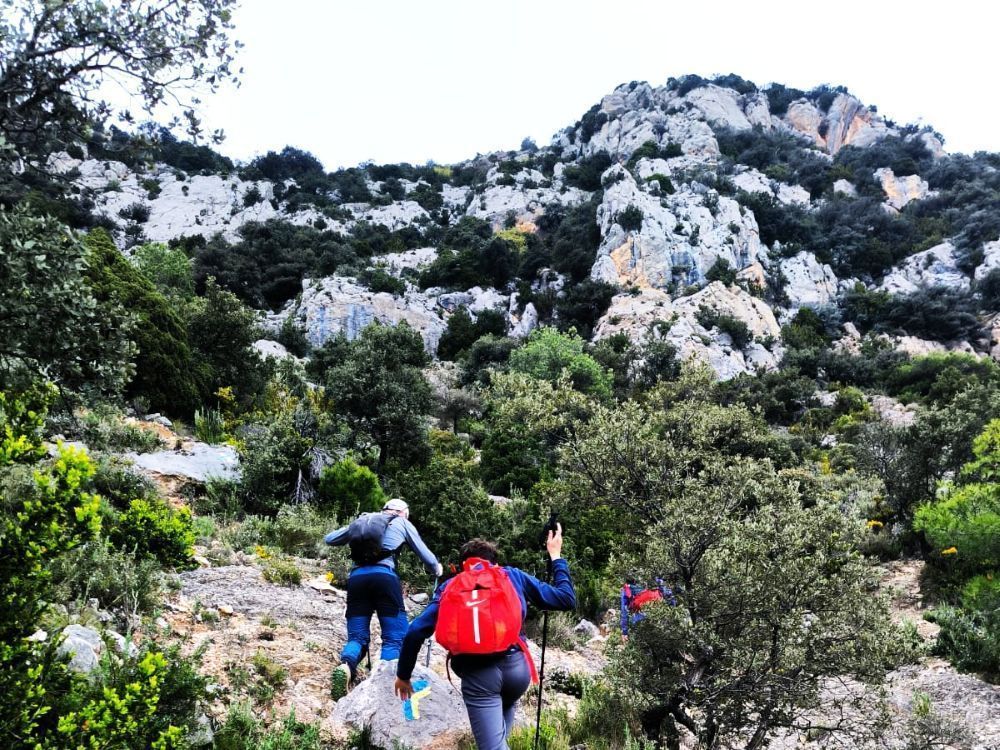
Going up to Santa Fe by the Grau del Fangueret Canal

At the start of the Grau del Fangueret Canal; below Fenollet
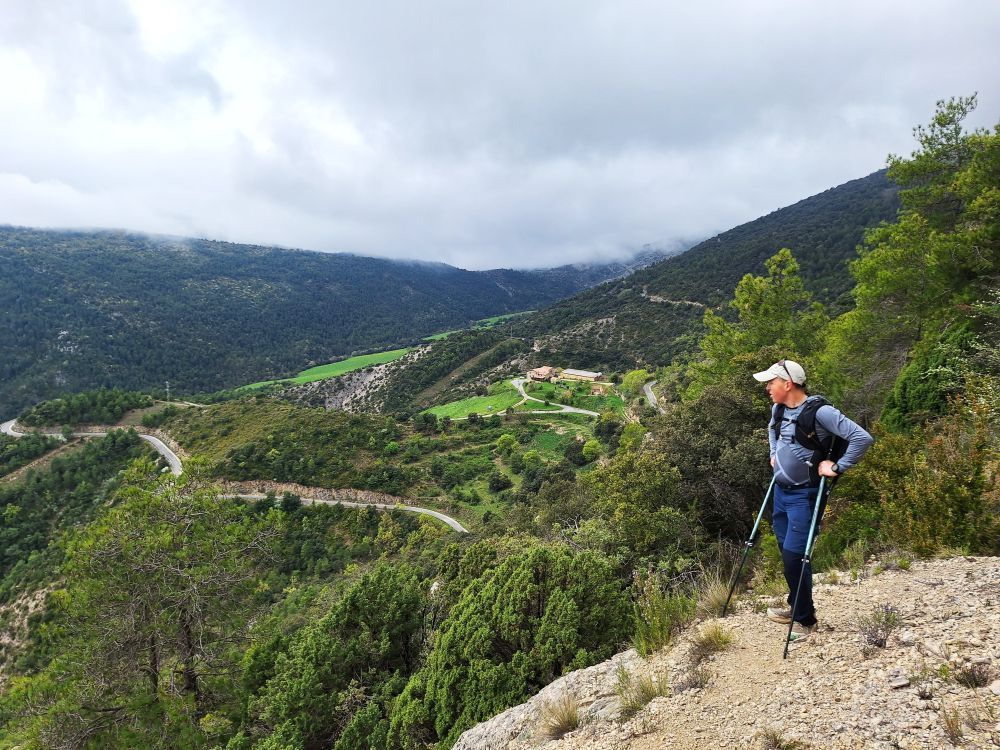
Arriving in Santa Fe; below Fenollet
With the accompaniment of an intense sun that made the climb more difficult, we overcame the Grau del Fangueret Canal, to then continue along a flat track to the Santa Fe pass. Leaving the path, we climbed in 15 minutes to the Santa Fe hermitage, where we had lunch, not without first following the local tradition of ringing the hermitage bell, which resounded throughout the valley, as a sign of protection. Despite the high clouds, the view of the surroundings was perfect, as well as the vultures and the occasional eagle that flew over the surroundings. We took the opportunity to take some good photographs.
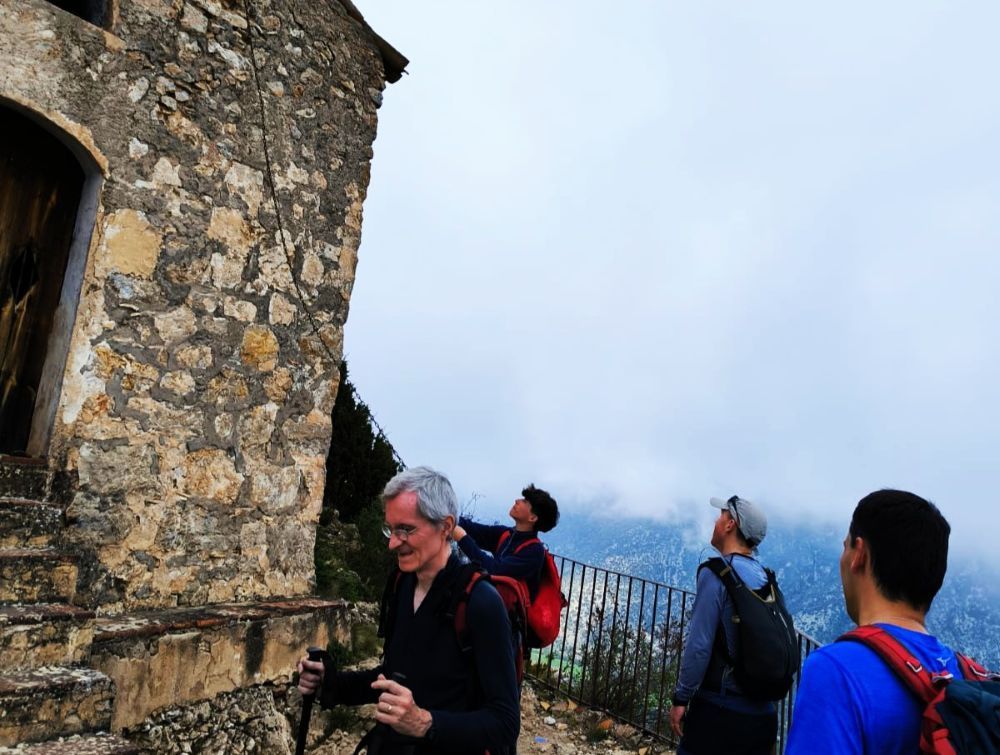
We have arrived at the Santa Fe chapel

View of the Vall del Segre from the Santa Fe chapel
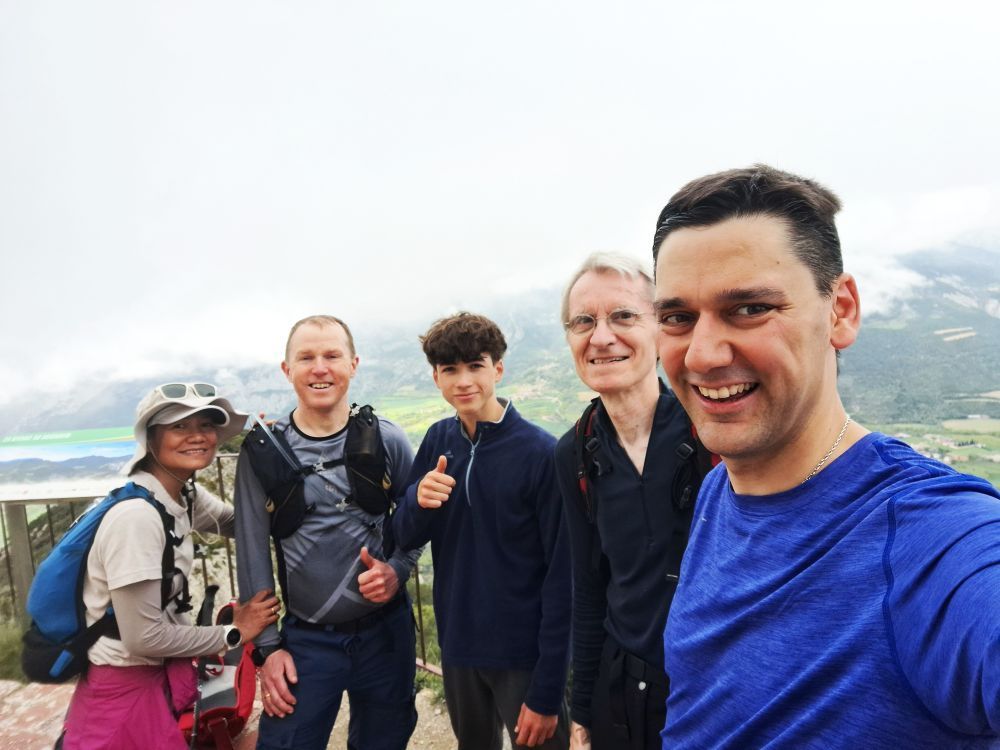
The group at the Santa Fe chapel
As the thunder sounded closer and closer, we began the descent without taking too long, once again taking the blue and yellow marks to leave them shortly after at the fork in the paths that lead, one to the Vall de Cabó, through the Casa de l’Oliva, and the other to Organyà, which is the traditional way up to the hermitage of Santa Fe. We followed the latter, leaving the path of Saint Josemaría. It is a vertical descent of about 500 m. along a very well-marked path in the siga saga with a regular slope.
Already in the final stretch of the descent, a heavy hailstorm hit us, forcing us to cover ourselves with the stones that were falling with force. Luckily, in a short time we reached the Organyà plain and the rain subsided, so that the final part of the route, to Coll de Nargó, was very pleasant. However, we had a point of emotion when crossing a stream on the way, usually dry, turned into a flowing river, due to the heavy rains, with the inevitable wet feet.
The final arrival at Coll de Nargó above the municipality, passing the Mirador, allowed us to appreciate some unusual views, as before, on the approach path, bypassing different interior hills.
An interesting experience to delve into the thoughts and sufferings of those walkers of 1937 and at the same time to better know the environment that this path crosses.


Leave A Comment