


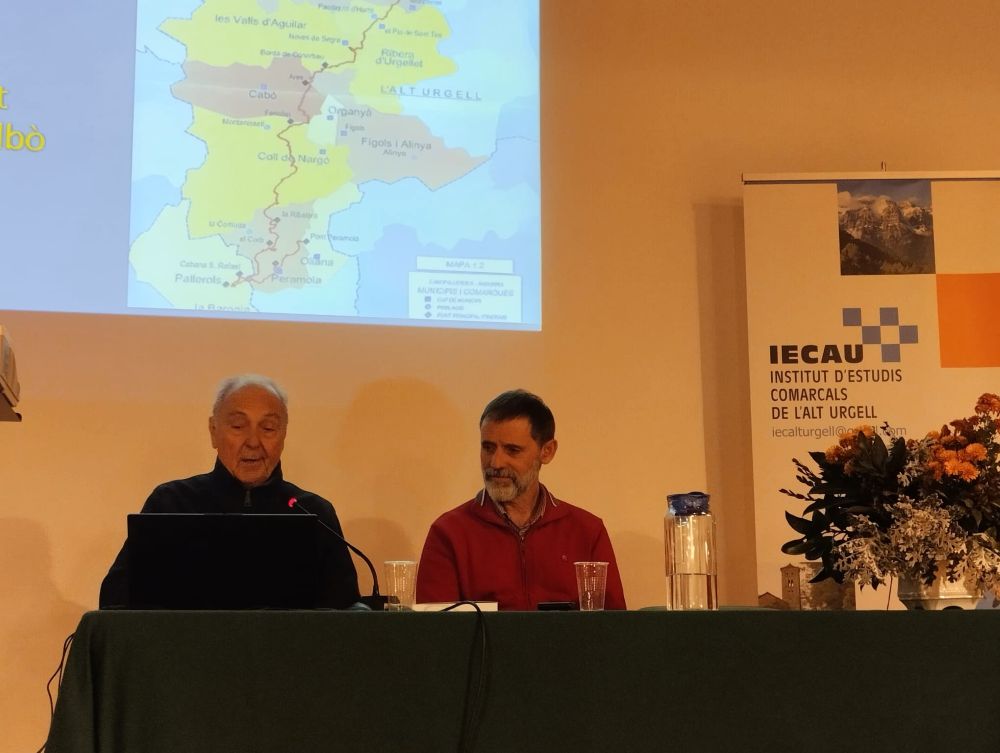
Jordi Piferrer at the beginning of his talk.
On Saturday, November 15, 2025, the VIII Alt Urgell Study took place at the Civic Center of Cabó (Alt Urgell), organized by the Institute of Regional Studies of Alt Urgell, the Association of Friends of the Vall de Caboet, and the Guitard Isarn de Caboet Ombudsman; and with the collaboration of the Generalitat de Catalunya Department of Culture, the Alt Urgell Regional Council, the Alt Urgell Regional Archive and the Cabó City Council.
About 50 people attended.

Photo of the speakers and some family membres.
The topics covered and the speakers were as follows:
PROGRAM
9:30 a.m. Presentation
9:45 a.m. NATURE
– Pere-Miquel Parés i Casanova: High chiropterological diversity in the Bescaran valley
– Bruna Planas Ponsa: Progress report on the study of two species of bats, Pippistrellus pippistrellus and Pippistrellus nathusii, on the border between Andorra and Alt Urgell
11:00 a.m. MEDIEVAL HISTORY
– Jordi Prat: Morphogenesis of the villages of the Castellbò valley
– José Antonio Tajadura Martínez: Sant Girvés de Peramola. Unique remains in a key location of the Carolingian March
– Carles Gascón Chopo: Two clandestine burials in Castellbò Castle during the Cathar period (12th-13th centuries)
– 12:00 pm
– Alan Ward Koeck: Dimensions and proportions of the church of Sant Serní de Tavèrnoles (Anserall, Valls de Valira)
– Carles Gascón Chopo: Francisco Pons-Sorolla and the restoration process of the church of Sant Serni de Tavèrnoles (1967-1975)
– Carles Gascón Chopo and Robert Lizarte Fernández: Sant Jaume de Llirt and Sant Jaume d’Engordany: two unknown altarpieces by the master of Tuixent (16th century)
– 4:00 pm MODERN HISTORY
– Alexandra Capdevila: French chaplains in Alt Urgell: immigration and presence (15th-17th centuries)
– Carmen Xam-mar Alonso: The leases of the City d’Urgell in the 18th century. Public service or a business opportunity?
CONTEMPORARY HISTORY
– Daniel Fité i Erill: The rationalization of the local administration of Urgell from the Delegation of the Judicial Party of La Seu d’Urgell (1923-1926)
– Jesús Bach-Marquès: Tragó de Segre and the Civil War. Context, vestiges and stories.
– Jordi Piferrer Deu: Camí d’Andorra: a path of fugitives and smugglers
– Pau Chica Fernàndez: Franco’s repression in Alt Urgell. An approach
– Marc Pont Fitó and Maria Vidal Lamolla: An approach to the post-war fortification in Alt Urgell
– Maria Vidal Lamolla and Marc Pont Fitó: Military presence on the Pyrenean border: the case of Alt Urgell
On behalf of the Association of Friends of the Camí de Pallerols de Rialb to Andorra, the Vice President of the Association, Jordi Piferrer Deu, participated, who presented the presentation: “Camí d’Andorra: a path of fugitives and smugglers”.
A summary of this presentation is:
-Camí d’Andorra: A 101 km long path of Freedom that crosses Alt Urgell from South to North and reaches Andorra.

Profile of the Andorra Trail.
-Well-documented stories of people in search of freedom, through this path. Presentation of the books “El pas dels Pirineus” and “Camino de Liberación” (408 pages) that describe 16 escape expeditions to Andorra.

Books “El pas dels Pirineus” and “Camino de Liberación”.
–Many people from the Alt Urgell region have generously collaborated in discovering the history and route of the Camino d’Andorra.
–Many volunteers have also cleaned and signposted the entire route, and keep it alive.
-There is a significant increase in people from all over the world who come to visit the Camino d’Andorra.
-Every year, around 500 to 800 people from all over the world walk part or all of the route from Oliana to Andorra. 50% come from Catalonia, 30% from Spain, 12% from Europe and 8% from the rest of the world.

Photos of people from all over the world who come to do the Andorra Trail.


Photos of people from all over the world who come to do the Andorra Trail.
-Just as the people of the region and many volunteers collaborate in an extraordinary way, we think that the collaboration of public organizations could improve. Some sections of the path where they should be more involved are in the maintenance of the following points:
Building wooden bridges over the Castellbó and Aravell rivers, building steps and railings in some particularly steep and dangerous sections, recovering some public fountains along the path, rebuilding dry-stone walls on the Comalavall path, improving the passage through Grau del Fangueret, improving the path up to Ares from Oliva de Cabó and other important arrangements, so that people from all over the world who increasingly come to do this path can enjoy the landscape, traditions and culture of Alt Urgell.


Molt interessants aquestes conferències sobre aspectes de l’Alt Urgell. Enhorabona per la participació